Watches / The Desk
Selfridges Adapts to Fragmented Luxury Demand by Rethinking Ground Floor Concessions
The department store is shifting from a reliance on prestigious handbag logos to curated accessories and outsourced watch partnerships to manage changing consumer preferences.
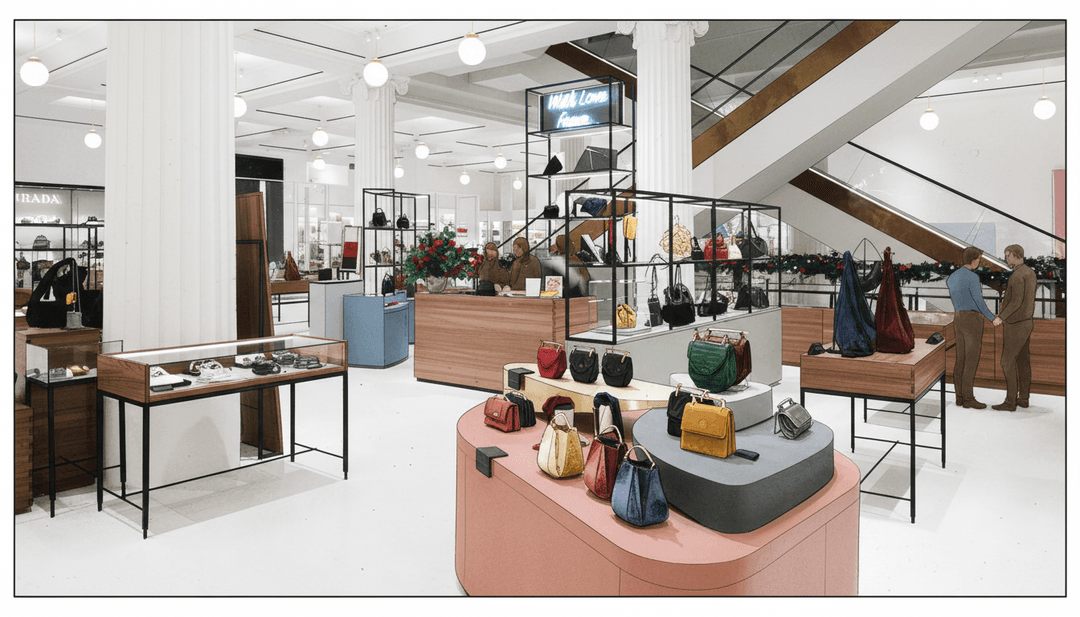
Selfridges is restructuring its ground-floor retail strategy to counter a selective and fragmented luxury handbag market, shifting away from a reliance on prestigious brand logos. As consumer purchasing habits become more considered, the traditional department store model of relying on major fashion houses to drive consistent volume is facing headwinds. This shift forces retail fiduciaries and brand managers to re-evaluate how floor space is allocated to maintain luxury consumer engagement.
According to WWD, Selfridges accessories director Sara Wong stated that the department store accessory floor can no longer exist merely as a collection of prestigious logos.[1] Wong noted that broad-market demand for major luxury handbag launches has slowed, with consumers showing fatigue toward repetitive designs and minor updates to established silhouettes.[1] Instead, spending is migrating toward smaller accessory categories such as jewelry, belts, and small leather goods, alongside contemporary and direct-to-consumer labels. This fragmentation of handbag spend occurs alongside a highly structured, outsourced model for other high-value categories on the same floor; WatchPro reported that the department store's luxury watch department, The Wonder Room, is operated as a concession run by Swiss retailer Bucherer.[2]
This dual approach reveals the underlying market mechanism department stores use to manage inventory risk and brand fatigue. In the handbag segment, Selfridges must actively curate a mix of high and low brands because consumer loyalty to specific heritage labels has weakened. Conversely, in the watch segment, the store mitigates inventory risk by outsourcing the entire multibrand floor to a specialist concessionaire. Bucherer manages the complex brand relationships and capital-intensive inventory for brands ranging from volume makers to high-end manufactures, shielding the department store from direct brand volatility.
These retail shifts have direct implications for the valuation and liquidity of luxury passion assets. The migration of primary-market spend away from repetitive handbag designs suggests that secondary-market valuations for mid-tier luxury bags may face liquidity constraints as consumer urgency declines. Meanwhile, the watch market's reliance on institutional concessionaires like Bucherer to manage retail presentation helps maintain primary price stability, though it concentrates distribution power.
The long-term efficacy of these retail strategies remains an open question. The available evidence does not disclose the private financial terms of the Bucherer watch concession, nor does it provide the exact margin comparisons between Selfridges' direct handbag curation and its outsourced watch operations, leaving the precise financial impact of this retail restructuring unquantified.
Related Coverage
Pricing Culturewatches - Sep 16, 2026
Luxury Watch Retailers Face Margin Squeeze From Soaring Gold Prices
Rising commodity costs are compressing profitability for major watch sellers even as robust demand in the United States prompts higher sales forecasts.
Recent coverage involving the same entity.
watches - Sep 16, 2026
Younger Demographics Drive Luxury Market Growth Forcing Brand Strategy Pivots
Demographic shifts are forcing legacy Swiss watchmakers and luxury brands to re-evaluate traditional retail timelines and pricing structures.
Recent coverage involving the same entity.
watches - Sep 11, 2026
Rolex Off-Catalog Allocations Highlight Growing Opacity of Primary Watch Market
The unpublicized distribution of gem-set references to brand ambassadors highlights the challenges of valuing assets that bypass traditional retail and public auction channels.
Recent coverage involving the same entity.
watches - Sep 14, 2026
Jérôme Marcu Debut Watch Highlights Value of Bench-Scale Craftsmanship
The release of the Marcu Initial showcases how independent watchmakers leverage decades of institutional experience to capture high-end collector interest.
Recent coverage involving the same entity.
Sources
- 01
Wwd
How Selfridges Is Navigating a Shifting, 'Fragmented' Handbag Market - WWDSep 3, 2026
Source passage
Given shifting fortunes in the handbag category, and lingering weakness, this linchpin floor in department stores “can no longer simply be a collection of the most prestigious logos.” So says Sara Wong, director of accessories at Selfridges , and also of its Reselfridges business. Here, she elaborates on the new rules of the handbag game. WWD: Overall, how would you describe the health of the handbag category over the past year or so? Sara Wong: The handbag category remains fundamentally important to luxury , but I would describe the market as more selective and fragmented than it was a few years ago. We are seeing less of the broad-based demand that allowed almost any major bag launch from a luxury maison to generate significant momentum. You May Also Like The customer has not stopped buying handbags , but the purchase has become more considered. There is greater scrutiny around price, design longevity, craftsmanship, functionality and brand relevance. At the same time, we are seeing spend migrate into other accessory categories — particularly belts, eyewear, jewelry and small leather goods, where the entry price can be lower and the product can feel more immediate or expressive. So I would not call it handbag fatigue in the sense that consumers are turning their backs on bags. I would call it fatigue with repetition: another iteration of an established silhouette or logo is n
- 02
Watchpro
GREATEST SHOWROOMS: The Wonder Room, Selfridges, London, UK - WatchProJan 23, 2023
Source passage
Most visitors to the legendary Selfridges department store in London’s West End have no idea they are entering a Bucherer-run space when they go shopping for luxury watches in The Wonder Room on the ground floor. Other than spaces dedicated to certified pre-owned watches and another for Bucherer Blue special edition pieces, the area’s branding is dedicated to the major luxury watches it offers in a vast multibrand floor and a number of boutiques around it. There is something for every taste and budget in the Wonder Room, ranging from volume brands like Tissot and Longines up to Breguet, Blancpain, Jacob & Co, Panerai and Girard-Perregaux. There are also boutiques surrounding the main “tradin