Watches / The Desk
Sotheby's Shifts Watch Strategy Toward Independent Makers as Rolex Asking Prices Fall
The auction house focuses on rare independent watchmakers and provenance as traditional secondary-market brand indices ease.
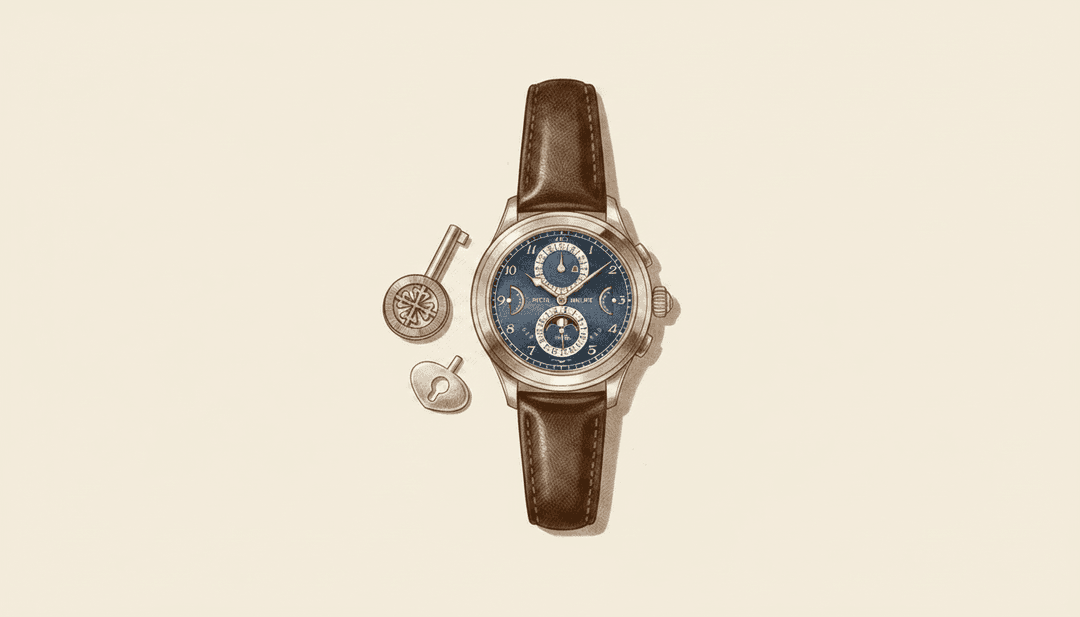
Sotheby’s is shifting its top-tier watch auction strategy toward early independent makers as secondary-market asking prices for mass-produced luxury references ease. According to WatchPro, the auction market for seven-figure watches has expanded beyond rare vintage Rolex and Patek Philippe references, driven by demand for independent watchmakers such as F.P. Journe, Rexhep Rexhepi, Kari Voutilainen, and Simon Brette.[2] This structural shift requires auction houses to cultivate highly specialized, direct collector networks rather than relying on broad-market brand recognition.
The transition is highlighted by the house's leadership structure, with Sotheby's appointing Geoff Hess as Global Head of Watches in 2023,[1], as reported by Esquire. Meanwhile, secondary-market asking prices for Rolex watches fell -5.15%[3] over ninety days and fell -22.25%[3] over the past year. These index movements track seller asking prices on secondary marketplaces rather than completed transaction values or net realizable returns, highlighting a divergence between retail-level supply and the highly insulated market for bespoke independent horology.
Before joining Sotheby's, Hess served as an international specialist at Phillips and as CEO of pre-owned specialist Analog Shift, Esquire reported.[1] Hess, who also founded the Rolliefest enthusiast gathering, told WatchPro that the current market represents a fundamentally different phase from the speculative frenzy of the pandemic-era boom.[2] In this environment, buyers are prioritizing craftsmanship, rarity, and provenance over short-term price momentum, which directly impacts how assets must be appraised for estate and insurance purposes.
This evolution in demand alters the risk and liquidity profile for high-value watch portfolios, requiring a clear distinction between different valuation standards. While the primary retail market remains soft outside the United States, WatchPro noted that auction demand is heavily concentrated on "rookie cards"—the earliest and most significant examples from independent brands with limited annual production runs—alongside highly documented neo-vintage Patek Philippe references and classic Paul Newman Daytonas. However, advisors must recognize that these public auction results represent gross transaction prices, including buyer's premiums, and do not equate to net realizable value for a consignor, nor do they establish an immediate collateral value for lending purposes.
For asset-backed lending and estate planning, relying on headline auction results to value a broader collection introduces substantial valuation risk. A standard production watch may face declining secondary-market demand and lower net realizable value, while an early independent masterpiece retains its capital preservation characteristics due to extreme supply constraints. Underwriting standards for watch-collateralized credit lines must therefore separate broad brand indices from the specific maker's annual production volume and the historical placement of the reference within their catalog. An appraisal for insurance replacement value, which must reflect the cost of acquiring an equivalent piece in a retail environment, will differ materially from a conservative collateral basis that assumes a rapid, distressed liquidation.
Ultimately, the institutionalization of the watch market is forcing a more sophisticated approach to custody and portfolio management. Collectors are increasingly treating their acquisitions as alternative assets requiring active management, where the gap between fair market value and net realizable value is highly sensitive to transaction costs and dealer spreads. As auction houses focus their top-tier sales on these highly coveted independent makers, the ability to verify provenance and maintain immaculate service records becomes paramount to preserving long-term asset value. The transition to a market defined by connoisseurship rather than speculation means that the long-term holding-period calculus must prioritize historical significance over short-term price momentum.
Related Coverage
Pricing CultureSources
- 01
Esquire
How Sotheby's Finds Hidden Watches Worth Fortunes (Like the Rolex Paul ...Source passage
This story originally appeared in About Time , Esquire's free weekly newsletter dedicated to the world of luxury watches. To get i t free into your inbox every Sunday at 8am, sign up here Geoff Hess has one of the most influential jobs in the watch industry. As Sotheby’s Global Head of Watches, the former lawyer oversees the sale of some of the world's most valuable timepieces. Before joining Sotheby's in 2023, he spent nearly five years as an International Specialist at Philips Auction House, having previously served as CEO of New York-based pre-owned watch specialist Analog Shift. A lifelong collector himself, he’s also the founder of New York’s Rolliefest, one of the hobby’s best-known enthusiast gatherings [we wrote about it here ], and a member of the Grand Prix d’Horlogerie de Genève Academy. Hess joined Sotheby's just as the auction world was becoming one of the most influential parts of modern watch collecting. As values climbed and increasingly significant collections came to market, the role of the auction specialist evolved from expert behind the scenes into one of the industry’s most visible figures. Earlier this month, Sotheby’s New York watch sale attracted bidders from 60 countries and delivered a string of record-breaking results , underlining both the scale of today's market and the responsibility that comes with selling its rarest pieces. This week I caught up
- 02
Watchpro
Sotheby's Adapts To Million Dollar Trophy Watch MarketSource passage
The market for million-dollar watches is no longer confined to the rarest vintage Rolex and Patek Philippe references. In the past two years, the number of seven-figure auction sales has surged to record levels, driven increasingly by the extraordinary demand for independent watchmakers including F.P. Journe, Rexhep Rexhepi, Kari Voutilainen and Simon Brette. As collectors compete for the earliest and most significant examples from brands producing only a few hundred watches a year, Sotheby’s Global Head of Watches Geoff Hess believes the market has entered a fundamentally different phase from the speculative frenzy of the Covid boom. Today’s buyers, he argues, are driven less by the prospect of quick profits and more by a deeper appreciation of craftsmanship, rarity and provenance. That shift is also reshaping demand for the industry’s biggest names, with collectors gravitating towards exceptional neo-vintage Patek Philippe references, iconic Paul Newman Daytonas and the very earliest iterations—the “rookie cards”—of the world’s most coveted watchmakers. WatchPro: The primary market for luxury watches remains fairly soft, particularly outside the United States, yet the auction market appears to be telling a different story. How would you describe the current state of the market? Geoff Hess: Interest is definitely more concentrated than it has been for some time, but on a macro
- 03
Pricing Culture Data
Patek Philippe market dossierAug 14, 2026
Source passage
Calculated deterministically from the recorded market observations cited in this story.