Brand Intelligence
Piaget Revives Its Ultra-Thin Minute Repeater in the Polo Collection
The Polo carries forward the Emperador Coussin’s chiming mechanism, with a partially openworked dial and a modern white gold case.
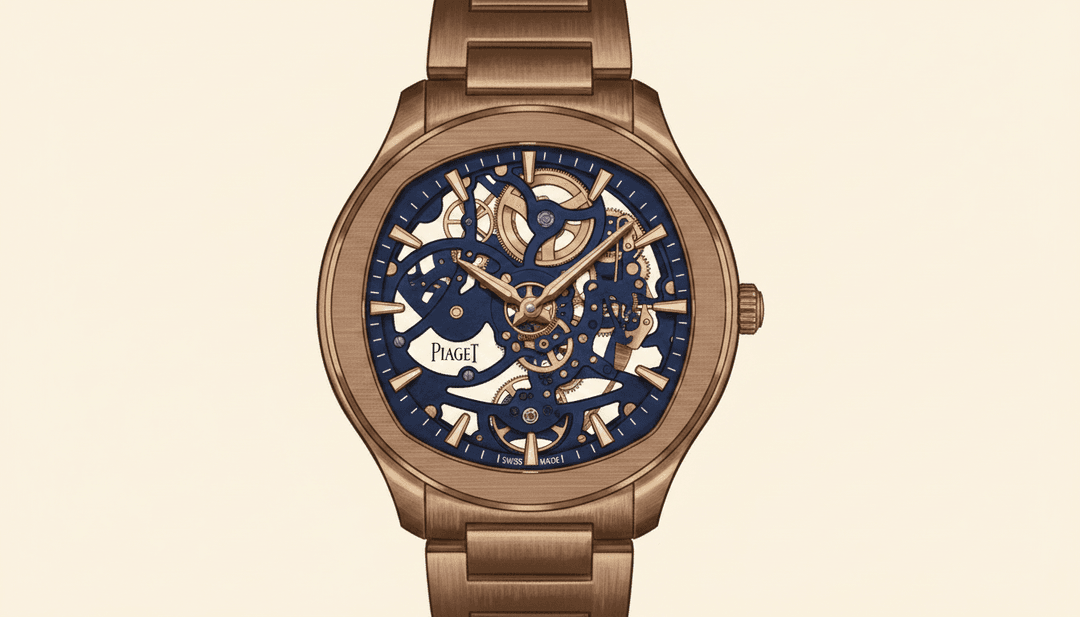
Piaget has brought its minute repeater back to the Polo, pairing a chiming complication with the collection’s modern sport-chic design. The return draws on a longstanding area of the manufacture’s work: Monochrome traces Piaget’s watchmaking reputation to ultra-thin movements and decorative techniques, and notes that its expertise includes major complications such as the minute repeater.
The Polo release has a direct predecessor. Watches by SJX describes it as a revival of Piaget’s once-record-setting repeater and says it shares its movement with the Emperador Coussin. Monochrome likewise notes that the chiming mechanism previously appeared in the Emperador Coussin Automatic Minute Repeater. The new watch therefore carries an established movement into a contemporary Polo case, rather than introducing the complication to the brand for the first time.
That continuity sits within a longer manufacturing history. Monochrome dates the Maison’s founding by Georges-Édouard Piaget in La Côte-aux-Fées to 1874[1][1] and describes ultra-thin mechanical calibres as a defining speciality. Its account connects the Polo repeater to that expertise through a familiar mechanism, rather than presenting it as a new movement developed for this release.
The case is broad and notably flat, a profile SJX attributes in part to the movement’s layered arrangement. The escapement, micro-rotor and repeater hammers sit on one plane, with the racks and centripetal governor above. Monochrome describes a white-gold case with a rhodium finish and a slide at the side to activate the repeater. Its proportions are a visible part of the design: SJX says the sizing may sit outside the current preference for smaller watches, while also describing the wide, flat shape as elegant.
The openworked dial joins the mechanism to Piaget’s decorative craft. Monochrome describes a white-gold dial with hand guilloché, blue accents and a sapphire ring; an aperture reveals parts of the movement, including the inertia wheel that regulates the chime. SJX calls the partially openworked treatment a departure from the fully transparent Emperador dial, balancing a view of the mechanism with a surface for the eye to rest on.
The movement’s decoration is visible as well as its architecture. Monochrome describes a self-winding calibre equipped with a platinum micro-rotor, hand-bevelled bridges, a guilloché mainplate and mirror-polished repeater hammers. It reports that the movement is conceived, developed, finished and assembled at Piaget’s La Côte-aux-Fées manufacture. That account locates the finishing in the same manufacturing setting named on the dial’s sapphire ring. The aperture frames the inertia wheel, the regulator dedicated to the repeater, tying a visible movement detail to the chiming complication.
Monochrome also reports acoustic research behind the hours-and-minutes chime. It describes a High Jewellery interpretation with blue sapphires and diamonds around a fully openworked dial. The standard version retains more dial surface, while the jewellery version displays more of its mechanism.
The product presentation extends the blue dial treatment to an embossed blue calfskin strap, with an additional alligator strap supplied, according to Monochrome.
The price is available on request, according to Monochrome. Its report describes a numbered edition and a very small planned production run; SJX also characterises production as extremely limited. Those accounts establish the product’s restricted availability, but they do not provide transaction results, resale evidence or a disclosed current retail price. The documented distinction from its predecessor is the case and dial presentation around an established chiming mechanism.
Sources
- 01
monochrome-watches.com
Introducing – The New Piaget Polo Minute RepeaterAug 31, 2026
Source passage
Piaget has long built its watchmaking reputation on a combination of ultra-thin movements and decorative techniques. Founded in 1874 by Georges-Édouard Piaget in La Côte-aux-Fées, the Maison developed its expertise in high-precision movements before making ultra-thin mechanical calibres one of its defining specialities. This expertise has also extended to major complications, including the tourbillon , chronograph , perpetual calendar and minute repeater. Now, Piaget brings back the chiming mechanism, previously featured in the Emperador Coussin Automatic Minute Repeater , to its modern sport-chic collection with the new Piaget Polo Minute Repeater. The new Piaget Polo Minute Repeater is presented in a 48mm white gold case with a rhodium finish, measuring 9.3mm in height, almost identical in size and shape to the watch that was once called the Emperador Coussin . The repeater is activated by the slide positioned at 9 o’clock, and the case is water-resistant to 30m. The dial brings together mechanics and decorative craftsmanship. Made of white gold, it is openworked and hand-guilloché, with blue PVD accents and a distinctive blue sapphire ring. A shaped aperture reveals parts of the movement beneath, and the sapphire ring at 4 o’clock bears the inscription “La Côte-aux-Fées” and frames the visible inertia wheel, the dedicated regulator of the minute repeater. The watch is powere
- 02
watchesbysjx.com
Striking Resemblance: The Piaget Polo Minute RepeaterSep 1, 2026
Source passage
More than a decade after unveiling its first in-house minute repeater, Piaget has revived the once-record-setting calibre in a familiar-looking guise. The new Polo Minute Repeater pairs the ultra-thin, micro-rotor cal. 1209P with the modern Polo case and a striking, partially open-worked guilloche dial. The Polo Minute Repeater is a new watch, but it bears a striking resemblance to the Emperador Coussin of 2013. This isn’t that surprising, since the contemporary Polo — refreshed in 2016 — borrows significantly from the Emperador’s case design. But in this case the similarity is more than skin deep, since the Polo Minute Repeater shares the same movement as its predecessor: the cal. 1209P. This ultra-thin calibre was once the world’s thinnest minute repeater — a title it maintained for three years before the launch of the Bulgari BVL 362, based on a 1980s Gerald Genta calibre. The Polo is big but flat, measuring 48 mm wide but just 9.3 mm thick. The size is partly due to the movement construction, which spreads out the major component groups into two slim planes with the escapement, micro-rotor, and twin minute repeater hammers on on one level, and the racks and centripetal governor on top. This 2010s-era sizing is arguably out of step with current fads where small watches are all the rage, but the watch is elegant and evokes 1970s “jumbo” watches with its wide-but-flat profile.