Brand Intelligence
Manufacturer-Backed Provenance Drives Exotic Car Valuations Over Seized Imports
A highly customized Mercedes-Benz SLR McLaren Stirling Moss heads to auction while a seized McLaren Senna struggles to find buyers despite deep price cuts.
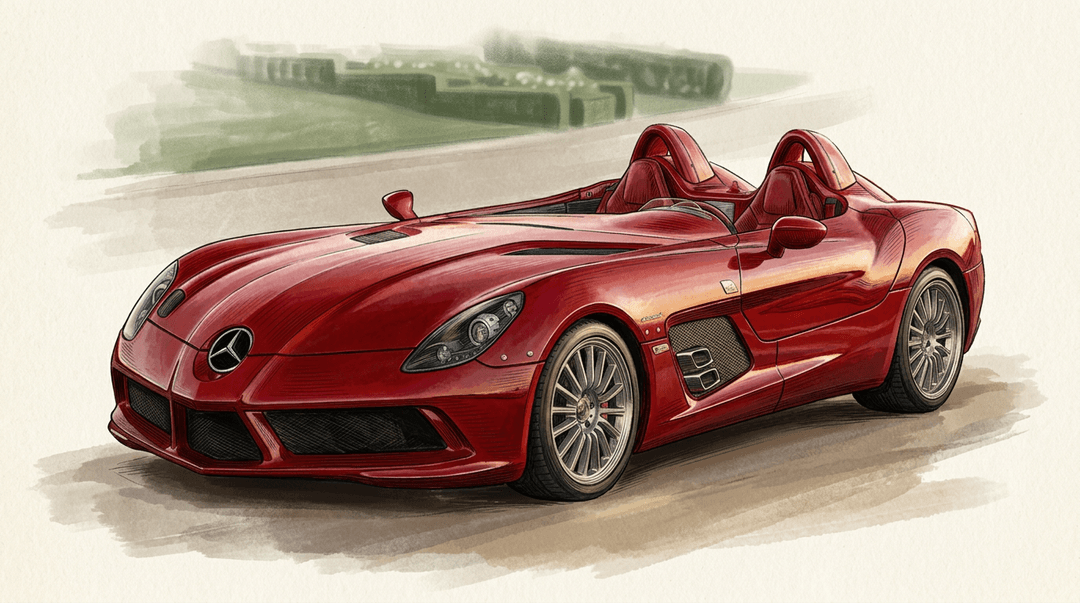
The stark divergence in secondary-market demand for elite supercars demonstrates that manufacturer-backed provenance and clear regulatory compliance command multi-million-dollar premiums, while assets lacking factory alignment face severe transactional friction. When an exotic vehicle is offered through established channels with fully documented ownership and factory-fitted specifications, the market responds with aggressive pricing. Conversely, when similar high-performance machines are sold through bureaucratic channels without manufacturer support, even steep discounts fail to attract buyers.
This valuation gap is clear when comparing recent market offerings. At an upcoming RM Sotheby's auction ending in 2026,[1] a highly customized 2010[1] Mercedes-Benz SLR McLaren Stirling Moss carries an estimate topping $6 million[1]. In contrast, a seized McLaren Senna offered by the Philippine Bureau of Customs struggled to find a buyer, prompting officials to slash the minimum bid from $1.6 million[2] to $1.35 million[2], which represents a $250,000[2] discount.
The premium commanded by the SLR McLaren Stirling Moss highlights the value of factory personalization and documented custody. According to Motor1, this specific vehicle was delivered new to the Royal Family of Kuwait, who kept it until the current consignor acquired it, leaving only two private owners across its entire lifespan. Furthermore, the vehicle features a rare Fire Opal Red paint finish and a factory-fitted audio system shared with only one other sibling car in the Jordanian Royal Family. Because the model was never built to United States specifications, its road legality required federalization through the National Highway Traffic Safety Administration's Show or Display program, a regulatory hurdle successfully cleared by its owners to preserve its utility and value.
By contrast, the seized fleet in the Philippines illustrates the severe liquidity issues that arise when vehicles are divorced from standard retail and manufacturer networks. Road & Track reported that the Philippine Bureau of Customs attempted to auction the Senna alongside a Ferrari SF90 Stradale for the fifth time after previous auctions resulted in a complete lack of registered bidders. The vehicles were originally seized in February of a prior year after an investigation revealed they were illegally imported by local dealers. Without manufacturer-backed documentation, warranty transfers, or clear import compliance, collectors hesitate to participate, leaving the government to repeatedly lower minimum bids to clear the inventory.
While older, limited-run collaborations like the Stirling Moss represent the peak of secondary-market desirability, the manufacturer is actively shaping its future lineup to maintain this brand equity. Autocar reported that McLaren is preparing for significant expansion under its new owner, the Abu Dhabi investment fund L'imad, which includes building a second factory in the United Kingdom and assembling its own engines in-house. The brand is also introducing a new naming convention, starting with the upcoming successor to the 750S supercar.
This new model, confirmed by Car and Driver to be named the McL 820, will transition the brand into its next generation of performance. The designation represents its metric horsepower output, which translates to 809 mechanical horsepower. By retiring the 750S and launching this new series-production hybrid supercar, the company aims to reinforce its position against mid-engined peers. For market participants, the introduction of in-house hybrid powertrains and structured naming conventions represents a deliberate effort to control supply and maintain the brand's primary-market pricing power, which ultimately supports the long-term secondary-market values of its most exclusive historic models.
Related Coverage
Pricing CultureCars - Nov 6, 2026
Seized Exotic Cars Face Severe Liquidity Friction at Government Auctions
A seized McLaren Senna and Ferrari SF90 Stradale struggle to find buyers at customs sales despite steep price cuts, contrasting with highly curated manufacturer heritage programs.
Recent coverage involving the same entity.
Cars - Nov 7, 2026
Lamborghini Revuelto SV Hybrid Supercar Establishes Premium Pricing Structure
The limited-production hybrid supercar features enhanced aerodynamics and chassis upgrades with a production run capped at 1963 units.
Recent coverage involving the same entity.
Cars - Nov 8, 2026
A 2006 Porsche Carrera GT Led the Artcurial Paris Sale
At the Automobiles sur les Champs auction, the top-tier supercar surpassed its high estimate, highlighting the premium buyers place on documented provenance and factory-backed preservation.
Recent coverage involving the same entity.
Cars - Nov 16, 2026
Aston Martin Defends Ultra-Luxury Positioning Through Traditional Performance and Lifestyle Partnerships
The British marque is pairing a traditional, combustion-only grand tourer strategy with high-concept collaborations to reinforce its long-term brand equity among collectors.
Recent coverage involving the same entity.
Sources
- 01
motor1.com
Last Mercedes SLR McLaren Stirling Moss Could Sell For More Than $6 MillionNov 10, 2026
Source passage
Mercedes-Benz built just 75 examples of the SLR McLaren Stirling Moss, and none of them came with a windshield, side windows, or a roof. One of the last ones off the line is about to test just how much that kind of exclusivity is worth. RM Sotheby's will offer a 2010 Mercedes-Benz SLR McLaren Stirling Moss at auction from November 26 through December 3, 2026, with an estimate topping $6 million. The car has covered just 32.9 miles since it left the factory in December 2009. The Stirling Moss used a supercharged 5.4-liter V8 making 650 hp , good for a claimed 3.5-second run to 60 mph and a top speed of 220 mph. Mercedes-Benz and McLaren built the run between June and December of 2009. This particular chassis is the very last one to roll out. 2010 Mercedes-Benz SLR McLaren Stirling Moss This car was delivered new to the Royal Family of Kuwait, who kept it until 2024, when the current consignor acquired it. That's only two private owners across the car's entire life, a rarity for a machine this valuable and scarce. It also carries factory-fitted features almost nobody else got. The car wears Fire Opal Red paint, a color applied to just a handful of Stirling Moss examples and never duplicated on this specific shade elsewhere in the run. A sibling car finished in Rosso Corsa has stayed with Jordan's Royal Family since new and is unlikely to ever reach the market. Inside, Mercedes-Be
- 02
roadandtrack.com
Seized McLaren Senna, Ferrari SF90, Other High-End Cars Head to Government Auction for 5th TimeOct 27, 2026
Source passage
It doesn’t sound unusual at first: the Philippine Bureau of Customs (BOC) seized a fleet of nearly a dozen exotic and luxury cars, including a McLaren Senna and Ferrari SF90 Stradale , and now it wants to sell the collection at auction. There's just one problem: Nobody seems particularly interested in buying any of them. According to a report by Philippine news outlet Bilyonaryo , this is the fifth attempt by the government to auction the vehicles. And this time, officials have slashed the minimum bid prices in hopes of finally attracting buyers. The BOC originally seized the 11 luxury cars in question back in February 2025. An investigation into a Pasay City car dealer and another business in Parañaque found that vehicles worth a combined ₱1.4 billion, or roughly $22 million, were illegally imported. The BOC decided to auction the collection, but selling the cars has proven considerably more difficult than seizing them. The previous auction, held on March 27, was a complete bust. Not a single bidder registered, and none of the cars sold. Hoping to avoid a similar result, the BOC is slashing prices. The minimum bid for the Senna was previously ₱102.04 million, or roughly $1.6 million; now it’s ₱86.74 million, which is approximately $1.35 million. That's still a considerable amount of money, but it's also about a $250,000 discount. (Your local McLaren dealership is unlikely to g
- 03
autocar.co.uk
'McL 820' – McLaren just dropped a big hint about its next supercarOct 29, 2026
Source passage
McLaren has hinted that the successor to its 750S V8 supercar, due next year, will be called the McL 820 – and pack almost as much power as Ferrari’s V12-engined 12Cilindri . McLaren’s first new series-production car since being acquired by its new owner, Abu Dhabi investment fund L’imad, could also be the first to follow a new naming convention established by the limited-run McL 6GT – as suggested by the firm in a central London publicity stunt today (29 October). The brand hid the moniker on a giant sculpture of its trademark kiwi mascot, which it placed in Covent Garden as part of a new marketing campaign. New Zealand-born company founder Bruce McLaren used the flightless bird as the logo for his racing team – which later spawned the road car division. McLaren has recently pledged to emphasise its heritage in future communications and products, and has adopted a new logo and typeface inspired by the signage on McLaren’s original workshop. That ties in to the use of McL for the new manual-equipped 6GT supercar, and the ‘McL 820’ teaser suggests it could be carried over to the core line-up too. The new look and naming strategy come as McLaren prepares for significant expansion . It is building a second factory in the UK, will start assembling its own engines in-house and will grow its line-up with a range of new models. The 'McL 820' will replace the brand’s core supercar, the
- 04
caranddriver.com
McLaren Confirms Next Supercar Will Be Called McL 820 and Have 809 HPOct 30, 2026
Source passage
McLaren has now confirmed that its next supercar will be called the McL 820. While we have very few details about the successor to the 750S , McLaren says “820” represents its metric horsepower, which converts to 809 mechanical hp. The new supercar will be revealed and go on sale sometime next year, and it’ll debut a new naming convention that starts with “McL.” Earlier this month, McLaren told the world that the 750S supercar will end production sometime next year. Naturally, we wondered what will come next. While there’s still a lot we have to learn, McLaren today confirmed the name of the successor to the 750S as well as its horsepower rating. The McL 820 will be McLaren’s next supercar. The name was initially teased on a giant kiwi statue (pictured below) that the automaker unveiled in central London, with its body wearing a camouflage wrap featuring the “McL 820” name. For anyone who is confused about why McLaren chose a flightless bird endemic to New Zealand as its mascot, the company’s founder, Bruce McLaren, is from that country and originally used the kiwi as a visual centerpiece for his racing team’s branding. See all results for used McLaren for sale near 94043 Like with McLaren’s previous model names, the numeric designation represents their output in metric horsepower (a.k.a. PS). That continues with the McL 820, with 820 PS converting to 809 mechanical horsepower.