Auction recap / Bonhams
Bonhams Vernacular Furniture, Naïve Art, and Textiles Auction Realizes £116,634
The specialized sale concluded with a 60.8% sell-through rate, led by early English oak carvings and intricate European decorative works.
Auction highlights
 Estimate£2.5–3.5KSold£10,880Latest bid—
 Estimate£7–10KSold—Latest bid—
A pair of 15th century English oak roof or hammer beam angels
Estimate£3–5KSold£8,960Latest bid—
A rare Elizabeth I engraved horn shoe horn by Robert Mindum Dated 1600
Estimate£5–7KSold—Latest bid— Estimate£4–6KSold—Latest bid—
 Estimate£1–1.5KSold£5,888Latest bid£4,600
An English carved oak misericord 15th century
Estimate£3–5KSold—Latest bid—
A large carved and painted limewood male term 17th century, probably South German
Estimate£3–4KSold—Latest bid—
A good Flemish carved oak bust of Saint James Late 16th century
Estimate£3–4KSold—Latest bid— Estimate£3–4KSold—Latest bid—
 Estimate£3–4KSold—Latest bid—
 Estimate£3–4KSold£3,840Latest bid—


Estimate track marks the pre-sale range; the tick marks the sold price. Lot photography: Courtesy Bonhams.
Contextual data provided by Pricing Culture Analytics; this is not an exhaustive list. Pricing Culture Analytics organizes publicly available auction data to analyze and produce insights.
The Bonhams Vernacular Furniture, Naïve Art, and Textiles auction, in a sale that closed on 6 October 2026, achieved a total realized figure of £116,634[1]. The specialized auction saw 101 of 166 lots sold, representing a 60.8%[1] sell-through rate for the session. Bonhams serves as the official result source for this auction[1], documenting the final outcomes of these historical pieces.
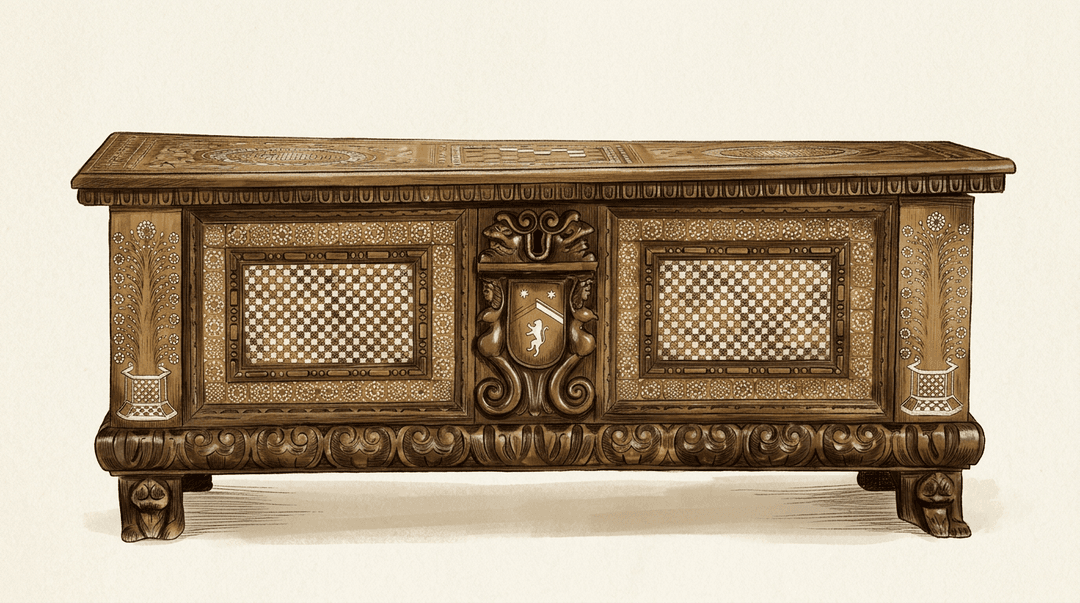
The auction presented a diverse selection of early European furniture, domestic objects, and religious carvings. Among the notable offerings was an Italian walnut and fruitwood cassone, featuring intricate ivory and bone 'alla certosina' or 'alla Veneziana' inlay. According to the Bonhams lot description, the piece is decorated with a profusion of geometric, star, and stylized foliate patterns[2], with alternating borders formed of tesserae and stringing. The inlay itself is comprised of a wide assortment of segments of various geometric shapes and proportions, principally lozenges. Its hinged overhanging top is inlaid with a central chess board tablet flanked by two smaller chequered lozenges each within concentric roundels, above a flute-and-leaf moulded edge.
Another significant historical object featured in the sale was a rare Elizabeth I engraved horn shoe horn by Robert Mindum. This piece of domestic history is intricately decorated with a fleur-de-lys motif, interlaced strapwork borders, and the initials ER. As detailed by Bonhams, it bears the engraved inscription "THIS IS FRANCIS HINSONS SHOE HORNE, GYVEN BY MARGREAT H AND ELISABEATH SMITH AND MADE BY ROBERT MINDVM" on its outer border, while the reverse is crudely engraved with the monogram EG.
Religious and architectural carvings also formed a core part of the sale's character. A pair of fifteenth-century English oak roof or hammer beam angels represents the craftsmanship of medieval church architecture. Each angel is carved with long flowing widespread hair and feathered arms holding a plain shield surmounted by merlons[4], measuring 35cm high, 16cm wide, and 6cm deep. Additionally, the sale featured a rare early English carved and polychrome decorated oak clock jack or 'Jaquemart' dating from the early modern period, with the figure carved in the manner of the documented Church of St Edmund clock jack at Southwold, Suffolk[5].
Auction highlights
Sale file- An Italian late 16th century ivory and bone 'alla certosina' or 'alla Veneziana' inlaid walnut and fruitwood cassone Possibly Venetian, the central heraldic panel probably of a later date: This lot was offered with an estimate of £2,500[2] to £3,500[2] and sold for £10,880[2].
- A pair of 15th century English oak roof or hammer beam angels: This lot was offered with an estimate of £3,000[8][7][4] to £5,000[7][4] and sold for £8,960[4].
- A good second half 16th century German relief carved walnut figural frieze panel depicting The Death of the Virgin: This lot was offered with an estimate of £4,000[8][6] to £6,000[6].
- An English carved oak misericord 15th century: This lot was offered with an estimate of £3,000 to £5,000.
- A large carved and painted limewood male term 17th century, probably South German: This lot was offered with an estimate of £3,000 to £4,000.
The market for vernacular furniture and naïve art relies heavily on the physical condition, provenance, and regional specificity of the pieces offered. The survival of delicate domestic items, such as the engraved horn shoe horn by Robert Mindum, highlights the historical value placed on signed and dated utilitarian objects from the Elizabethan period. Similarly, architectural survivals like the hammer beam angels and the early English clock jack reflect the enduring interest in medieval and early modern woodcarving traditions. These objects represent specialized collecting categories where historical documentation and decorative appeal drive collector interest.
Sources
- 01
- 02
- 03
- 04
- 05
- 06
- 07
- 08