Cars / The Desk
Lotus Elise Restomod Repositions the Marque Into the Supercar Price Bracket
A bespoke commission from Analogue Automotive commands a substantial premium, establishing a new valuation ceiling for the lightweight British platform.
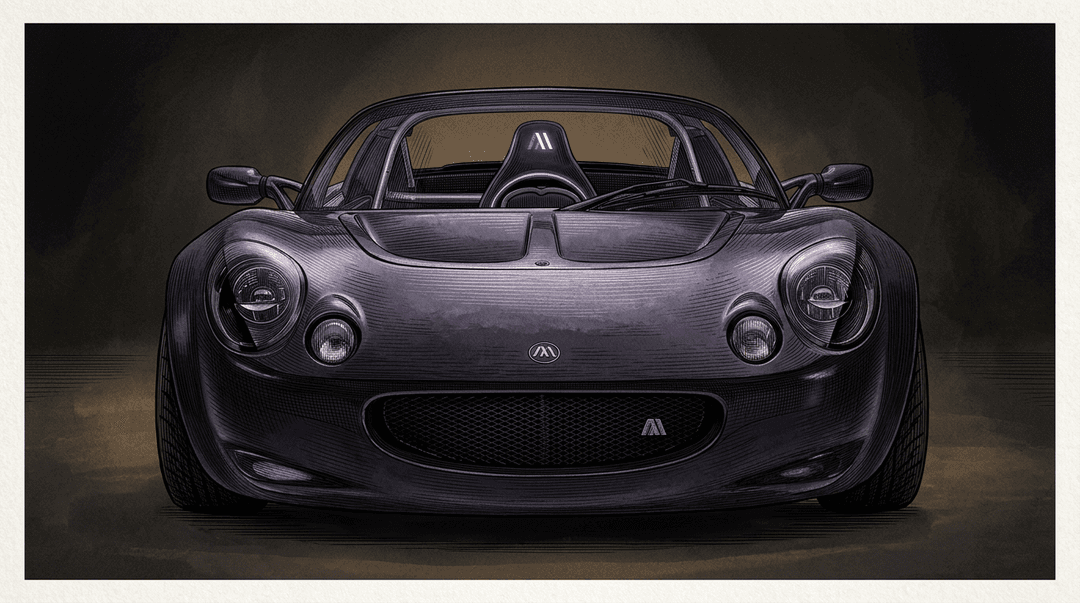
The debut of a single-seat Lotus Elise restomod priced on par with modern supercars represents a deliberate effort to reposition the historically accessible British marque into the high-net-worth collector market.
This custom build, developed by UK-based specialist Analogue Automotive, carries a base price starting at £350,000[1], according to Carscoops. This pricing structure places a vehicle historically valued as an entry-level sports car into direct competition with contemporary Ferrari models, as Car and Driver reported.[2]
The premium pricing of the Analogue Automotive VHPK relies on extreme weight reduction and mechanical exclusivity rather than raw horsepower. Ditching the passenger seat for a central-driving layout—reminiscent of three-seat supercars—and replacing body panels with carbon fiber reduces the overall weight of the original Elise donor chassis. Power comes from a heavily reworked Rover K-Series engine tuned to exceed the output of the original factory variant. This mechanical overhaul targets collectors seeking analog driver engagement, a segment where buyers increasingly value tactile feedback over the sheer acceleration of modern hybrid or electric drivetrains.
This shift to low-volume, high-margin commissions alters the valuation landscape for the first-generation Elise. When Lotus discontinued the production of the Elise in 2021[1], it left a supply vacuum for enthusiasts of the lightweight platform, Carscoops noted. While standard road-going examples of the original Elise trade at a fraction of this restomod's cost, the VHPK establishes a new ceiling for what the market might bear for an upgraded variant. This development introduces a stark division between standard production models and bespoke commissions, meaning traditional appraisal metrics based on historical auction results of factory-spec cars no longer apply to these heavily modified, low-volume builds.
Whether the secondary market will validate this pricing tier remains an open question. While established restomod builders have successfully created a robust secondary market for Porsche commissions, the Lotus brand has historically lacked the same level of investment-grade collector demand. The ultimate liquidity of these custom builds will depend on whether future auction results can sustain these premium valuations once the production run is completed, or if the lack of factory provenance will limit their appeal to a highly specialized subset of the market.
Related Coverage
Pricing Culturecars - Sep 11, 2026
Premium Electric Vehicle Valuations Face Pressure From High-Performance Mass-Market Alternatives
The substantial price spread between legacy luxury electric SUVs and quicker mass-market rivals highlights a shifting dynamic in brand-equity preservation.
Recent coverage involving the same entity.
cars - Sep 8, 2026
Entry-Level Classic Car Auctions Fail to Provide Reliable Portfolio Valuation Baselines
While digital platforms expand listing volumes, the absence of verified transaction prices prevents wealth managers from using these entry-level classic car assets as collateral.
Recent coverage involving the same entity.
cars - Sep 9, 2026
Hampton Court Peer-Voted Concours Format Alters Rarity Valuation Baselines
The collective appraisal of participating owners at the UK event replaces traditional judging rubrics, rewarding narrative provenance over standardized restoration points.
Recent coverage involving the same entity.
cars - Sep 9, 2026
Aston Martin Model Shifts Alter Residual Value Curves
The British marque's transition to higher-margin vehicles narrowed its operating loss during its restructuring period, reshaping the supply dynamics of its modern sports cars.
Recent coverage involving the same entity.
Sources
- 01
Carscoops
A Used Lotus Elise Costs $28K. This Center-Seat Restomod ... - CarscoopsSep 2, 2026
Source passage
Analogue Automotive finished the first single-seat Lotus Elise VHPK. The sub-600 kg restomod makes 250 hp from a tuned 1.9-liter engine. Production is capped at 35 units, priced from £350,000 ($472,500). Lotus killed the Elise in 2021 and never lined up a replacement, which has done nothing to thin out the people who still want one. UK-based Analogue Automotive, a firm built entirely around upgrading the first-generation car, is now assembling the VHPK restomod . The limited-run build gets a lighter carbon fiber body, a central driving position, and enough chassis and engine work to push its power-to-weight ratio into territory road cars rarely visit. More: The World’s Fastest Four-Banger Just Got Faster Exactly one year after announcing the project , Analogue Automotive has completed its first customer car. The donor, a ’90s Elise S1, was stripped and rebuilt with nothing left untouched before any of the upgrades went on. The finished car wears a bespoke PK Purple paint, matching Alcantara trim inside, and gold dual tailpipes. The McLaren F1 Seating Trick, Applied To A Lotus The headline feature of the VHPK is its central driving position with a single carbon fiber bucket seat in the middle of the tub. The layout draws inspiration from the single-seat Elise racecars that competed in the Autobytel Lotus Championship. The interior is spartan, with A/C and a removable carbon hard
- 02
Caranddriver
This Elise Restomod Promises the Ultimate Lotus Experience for a PriceSep 7, 2026
Source passage
With only a single center-mounted seat and plenty of carbon fiber, this S1 Elise restomod weighs just 1320 pounds. Unfortunately, it's also priced like a modern Ferrari. Then again, charging more for less has always been part of the Lotus business plan. It takes a very special sort of brain to look at a S1 Lotus Elise and think, “Way too heavy. What are we doing here, building Lincoln Town Cars?” However, that sort of mindset was espoused by Lotus brand founder Colin Chapman, and you'd have to expect ol' Colin wouldn't be too upset about the latest reimagining of one of the best cars to wear his initials on its badge. This is the Analogue Automotive VHPK, and the cost per gram here is on a level with precious jewels. Tipping the scales at just 1320 pounds, it carries a hefty price tag of some $470,000. That's over a thousand pounds lighter than a soft-top Mazda MX-5, for the price of a well-optioned Ferrari 296GTB. See all results for used cars for sale near 29405 For that kind of money, the VHPK needs to offer a singular driving experience, and it does. Literally, there's only one seat mounted in the middle. Ditching the passenger's seat helps cut down on weight, and further savings are realized through the use of carbon fiber. Composites aren't cheap, and this is what drives the price of the VHPK up, and it is also extremely exclusive. Only 35 of them will be built to order,