Auctions / The Desk
The Auction Result Is Not the Seller's Proceeds
Negotiated private transactions and structured consignment fees mean the final cash returned to a seller diverges significantly from public hammer prices.
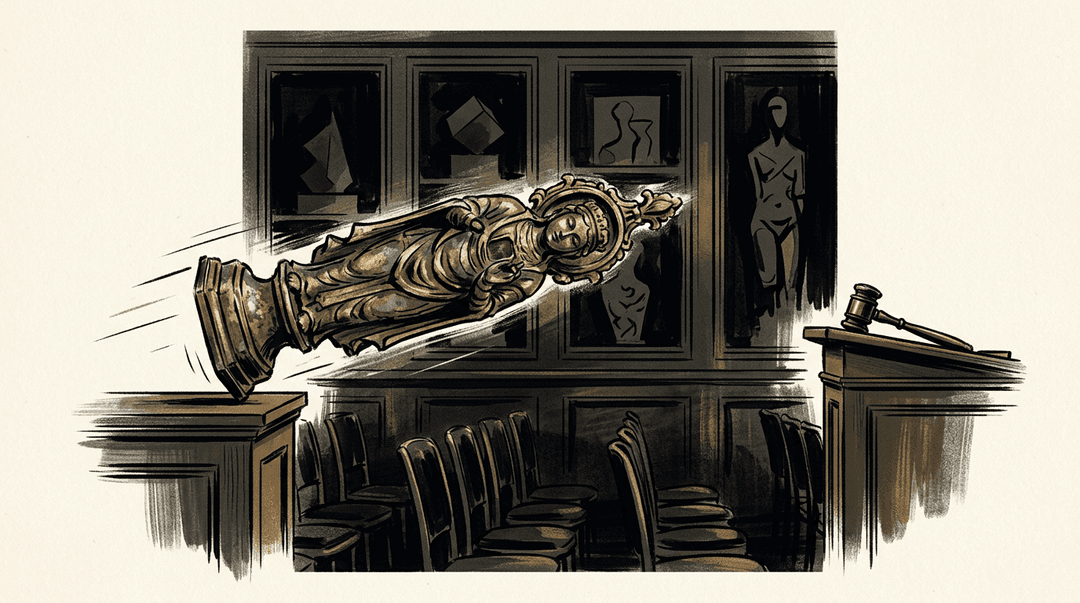
The public hammer price realized at auction does not represent the actual net proceeds a seller receives. While headlines focus on the spectacle of the bidding floor, the financial reality of a consignment is determined by a complex web of reserves, seller commissions, marketing fees, and administrative charges. Choosing the optimal route to market requires a detailed comparison of these transactional frictions against alternative transaction methods.
The divergence between public results and realized cash is documented across major market participants and historical transactions. According to the Financial Times, in 2018,[1] private transactions at Sotheby’s reached $1bn[1] for the first time, representing a significant portion of the firm's consolidated sales value of $6.4bn[1]. During the same period, Christie’s reported that its private sales rose 7 per cent[1] to reach $643.3m[1]. These figures demonstrate that a substantial portion of high-value transactions occur outside the public auction room, where sellers negotiate terms directly to control net proceeds and avoid the public deductions associated with live bidding.
The primary mechanism governing a public auction is the reserve price, which Christie's defines as the minimum amount the seller is willing to accept. If bidding fails to meet this threshold, the lot remains unsold, creating a public record of non-sale that can affect the future marketability of the asset. Furthermore, even when a lot sells, the hammer price is subject to seller commissions and optional promotional fees. These deductions mean the net cash returned to the consignor is always lower than the public result, which includes the buyer's premium paid to the house rather than the seller.
For highly volatile contemporary art, the timing of a transaction can be more critical than the potential for a bidding war. The Art Newspaper reported that contemporary art accounted for the largest share of Sotheby’s private sales in the tranche above $1m[2] over a multi-year period. David Schrader, the global head of private sales at the firm, noted that compressing market cycles mean the outlook for certain artists can change rapidly, prompting vendors to sell immediately rather than waiting for a scheduled seasonal auction. Private sales allow owners to transact year-round, avoiding the risk of public price declines if market tastes shift before a catalog is printed.
Discretion also serves as a protective barrier against reputational friction. Sellers of recently acquired works often seek to avoid the accusation of flipping, which is heavily discouraged by primary galleries and can lead to blacklisting. A private transaction ensures that ownership changes hands without public scrutiny. Additionally, primary galleries are often reluctant to accept resales of works they recently sold, as they prefer to focus on fresh inventory where they retain a higher portion of the sale price. In such cases, a private brokerage through an auction house becomes the most viable path to liquidity.
Ultimately, the decision to consign publicly or sell privately depends on a rigorous assessment of execution certainty versus competitive upside. Public auctions offer the potential to drive prices above estimates when multiple buyers compete, but they require sellers to accept public exposure, fixed calendar dates, and variable net proceeds. Private transactions trade the possibility of an extraordinary bidding war for immediate timing, absolute discretion, and contractually guaranteed net figures. Evaluating these trade-offs based on net realizable value rather than headline hammer prices remains the essential standard for managing high-value cultural assets.
Evidence limits: the sale total is not recorded; the valuation basis behind the figures is not disclosed in enough depth. Until those gaps close, the reported total does not establish sale breadth, comparable quality, risk-transfer support, or post-hammer net value, and it cannot serve as a collateral-value mark.
Related Coverage
Pricing Culturejewelry - Sep 23, 2026
Private Sales Channels Transform Into Primary Liquidity Venues for Cartier and Heritage Assets
As market cycles compress, sophisticated collectors are bypassing public auction volatility in favor of structured, off-market private-treaty transactions.
Recent Pricing Culture context on this market.
collectibles - Sep 20, 2026
Private Sports Photo Sales Limit Broad Market Price Discovery
A record transaction for the original photograph behind Mickey Mantle's foundational card highlights the valuation challenges facing advisors in the opaque market for vintage sports photography.
Recent Pricing Culture context on this market.
collectibles - Sep 19, 2026
Live-Streamed Art Auctions Limit Price Discovery Through Proprietary Silos and Bot Barriers
The shift toward digital-only sales formats restricts public access to transaction data, leaving valuation experts without verifiable benchmarks.
Recent Pricing Culture context on this market.
Bonhams - auction - Sep 14, 2026
Bonhams Asian Art Sale Realizes £1,173,184 With High Estimate Surprise Rate
The London auction cleared 78.4% of its lots, driven by strong demand that pushed multiple items well above their high estimates.
Recent Pricing Culture context on this market.
Sources
- 01
Ft
The rise of private sales at auction houses - Financial TimesMar 7, 2019
Source passage
Roula Khalaf, Editor of the FT, selects her favourite stories in this weekly newsletter. Sotheby’s kicked off this week’s Modern and contemporary art auctions with a sprightly evening sale that made a total of £77.9m (£93.3m with fees, est £75.5m-£104.5m). Top lot was Jean-Michel Basquiat’s appropriately titled “Apex” (1986), which nudged ahead of its presale estimate to sell for £7.1m (£8.3m with fees). Back in 1988, this work sold for £16,500. Other seven-figure sums reached on Tuesday evening included Lucian Freud’s small “Head of a Boy” (1956), a painting that had been owned by its late subject, the Guinness heir Garech Browne, and which sold for within its already punchy estimate for £4.9m (£5.8m with fees). Much of the action was unsurprising — both works were among 22 lots out of the 66 offered that carried third-party guarantees (a further four works were guaranteed by the auction house and all sold). A sell-through rate of 91 per cent is nonetheless impressive. The only hiccup came when a bidder in the room ostensibly bought Philip Guston’s “Lamp” (1979) for £1.5m and then — waving a champagne glass instead of an official paddle — proved a false buyer. Auctioneer Oli Barker coolly re-offered the lot later on, when it sold to its third-party guarantor for £1.4m (£1.7m with fees). Christie’s equivalent auction felt faster-paced on Wednesday and also sold well (93 per cen
- 02
Theartnewspaper
Backroom deals for wet paintings: why contemporary art is driving ...Apr 6, 2023
Source passage
I was most intrigued by one finding of Sotheby’s recent report, Peak Performance, compiled by ArtTactic, which recorded sales in the $1m+ tranche over the period 2018-22. The report, using internal information from Sotheby’s private sales data, said that contemporary art accounted for the largest share of the firm’s private sales—almost 60%! I would have expected Impressionist and Modern art to represent the biggest chunk, and indeed it accounted for just over half of sales by value in the $1m+ category. However, as David Schrader, the firm’s global head of private sales, explained to me, “The number of transactions is much higher in the contemporary field, and this is a much more active market, which is why it is larger in volume.” For the record, his department turns over between $1bn and $1.5bn each year. Drilling down, it was interesting to hear that shortening cycles in the art market are driving this trend. Schrader again: “The cycles are compressing, and the market for some artists may change in six months’ time. Vendors may not want to wait for a suitable auction, they may want to sell immediately.” There could be no clearer indication of how volatile this market can be, particularly for the “wet paint” or "ultra-contemporary" works of art. Owners may want to grab their profit while they can. And in view of the current uncertain economic climate, with banks crashing aro
- 03
Christies
Should I sell at auction or through private sale? - Christie'sSource passage
Whether selling art, jewellery or watches, one of the first decisions is how to bring the work to market, with auction and private sale being the two principal routes. Both offer access to specialist expertise and an international network of collectors, but the right approach depends on the work, current market demand and the seller’s objectives. An auction is a public sale where multiple buyers compete for an artwork or object, with bidding determining the final price. Christie’s holds regular auctions in more than 80 art and luxury categories, both live and online. At live auctions, bidders can participate in person, by telephone, online or through absentee bids. The auctioneer introduces each lot and takes the bids. For online-only auctions, the bidding takes place on christies.com over several days. If bidding meets the reserve price — the minimum amount the seller is willing to accept — the lot is sold to the highest bidder. Private sales offer a more discreet, bespoke alternative, selling fine art and objects outside of the auction room. Christie’s specialists draw on their global network to connect buyers and sellers, negotiating and brokering transactions directly between them. The key advantage of auction is competition. Rather than agreeing a price with a single buyer, multiple collectors can compete for the same work. When there is strong demand, this can drive the f