Brand Intelligence
Omega Coordinates Competitive Pricing Strategy to Stimulate Demand and Optimize Factory Capacity
The Swiss manufacture is holding prices steady on updated compact chronographs to counter industry-wide volume declines and maintain production levels at its manufacturing plants.
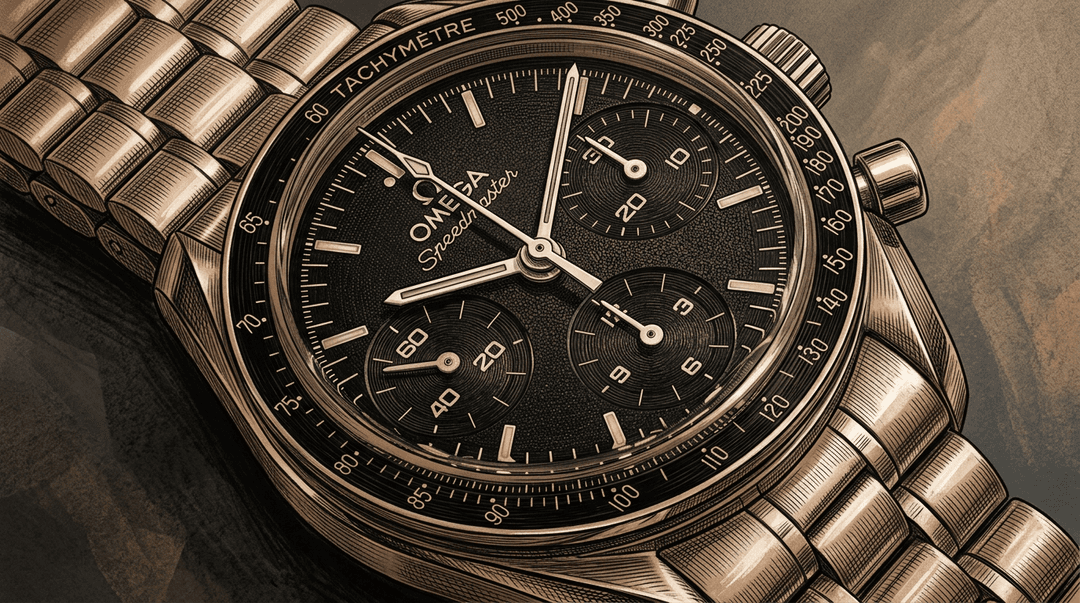
Omega is pricing its new releases more competitively to stimulate demand and optimize manufacturing capacity, diverging from the Swiss watch industry's trend of raising prices while volume declines.
This pricing posture is visible in the retail positioning of the new compact Speedmaster collection. As reported by WatchPro, the brand has positioned its new range of compact Speedmasters in stores at £5,600[1]. This retail pricing reflects a broader decision by the manufacture to hold prices steady and stimulate consumer demand, contrasting with competitors that have raised prices to defend luxury positioning despite falling volumes.
The product strategy supports this commercial push. Revolution Watch reported that the compact Speedmaster, first introduced in 2017[2] as a successor to the automatic model produced from 1988[2], has undergone design revisions to align it closer to the classic Moonwatch. By replacing oval subdials with conventional round registers and restoring traditional bezel details, the manufacture is attempting to broaden the appeal of its entry-level chronograph catalog. This design alignment serves as a mechanism to capture buyers who seek classic aesthetics at a more accessible retail price point.
The decision to prioritize volume and capacity utilization comes amid a wider divergence in Swiss watch exports. WatchPro noted that Swiss manufacturers are generally producing fewer watches while charging more per unit, with the ultra-luxury segment driving overall growth.[1] While some brands have doubled average retail prices over a multi-year period to maintain luxury positioning, Omega has kept price increases below inflation over the same timeframe. For a brand managing large-scale manufacturing facilities, maintaining production volume is essential to cover high fixed operating costs, making price restraint a pragmatic tool to prevent underutilization.
Advisors evaluating client collections must consider how this divergence in brand strategy alters the risk profile of secondary-market valuations. Brands that artificially inflate retail prices to project luxury status face the risk of secondary-market corrections if demand continues to soften. Conversely, Omega's competitive retail pricing may stabilize secondary-market values by narrowing the spread between retail and secondary prices. The unresolved question for fiduciaries is whether this volume-driven strategy will protect long-term brand equity or if the increased market supply will eventually weigh on secondary-market price stability.
Related Coverage
Pricing Culturewatches - Sep 7, 2026
Blancpain Uses Downsized Archival Civilian Design to Diversify Its Collector Base
The new limited-edition Fifty Fathoms Bathyscaphe reproduces a compact midcentury reference to target buyers seeking wearable, non-military luxury sports watches.
Recent coverage involving the same entity.
watches - Sep 8, 2026
Vacheron Constantin Bypasses Retail Benchmarks With Unpriced Concept Watches
The manufacture's new Tribute to the Animal Kingdom series uses independent artisans to shift the valuation basis from mechanical specifications to unpriced artistic scarcity.
Recent coverage involving the same entity.
watches - Sep 8, 2026
Patek Philippe Sports Models Face Dual Pressures of Street Theft and Cheap Homages
The stark valuation gap between genuine luxury references and low-cost design replicas highlights the shifting risk profile of public watch ownership.
Recent coverage involving the same entity.
watches - Sep 8, 2026
Blancpain Bifurcates Dive Catalog to Capture Modern and Historical Collector Segments
The Swiss manufacture is balancing extreme titanium tool watches in its permanent collection with highly limited, downsized midcentury reissues to capture distinct segments of collector demand.
Recent coverage involving the same entity.
Sources
- 01
watchpro.com
CORDER’S COLUMN: Omega has come to its senses on price - WatchProSep 8, 2026
Source passage
Two watch launches stick in my mind from this summer because of what they say about Swiss manufacturers’ approach to price. First was Omega ‘s new range of 38mm Speedmasters, which are in stores now priced at £5,600. The other is a collection of four Zenith Chronomaster Solo Sport models, three of which cost £9,700. Price, and particularly value for money, have become hot topics in Switzerland because the country’s entire manufacturing sector is making fewer watches while charging more for each piece. This shows up in Swiss export figures where watches with retail prices between CHF 50,000 and CHF 125,000 have risen by almost 8% between H1 2025 and H1 2026. Over the same period, exports of watches costing CHF 2,500 to CHF 7,500 at retail have declined by 6.3%. Industry analyst LuxeConsult points out that the ultra-luxury segment has delivered 75% of year-on-year growth across all price segments despite unit sales rising by just 1.3%. There is a reasonable argument to be made that watch manufacturing in Switzerland should be concentrated entirely on ultra-luxury watches, because it is uniquely placed to deliver products built on centuries of history, iconic designs and world-leading finishing. But tens of thousands of jobs would be lost in small workshops and large factories that produce components and finished watches with five-figure prices. Which brings me back to Omega and Z
- 02
revolutionwatch.com
Omega brings the Speedmaster 38mm closer to its Moonwatch roots - Revolution WatchAug 25, 2026
Source passage
Beyond what it represents as a symbol of one of the greatest, and certainly highest, human adventures, one of the reasons the Speedmaster has endured so widely is the extraordinary variety contained within the name. Each has offered a slightly different way into a watch that has somehow managed to unite enthusiasts despite the very different paths their collecting may take. Almost everyone comes to the Speedmaster at some point, but for every enthusiast who insists the Moonwatch is the only one that matters, there is another who prefers a commemorative, an automatic, a reduced case, a more exotic metal, or something altogether more colourful. The range today offers something for everyone. The Speedmaster 38 has always occupied a quieter corner of the family. Introduced in 2017 as a more compact counterpart to the flag-bearer 42mm models, it had a precedent of sorts in the Speedmaster “Reduced”, the smaller automatic model produced from 1988 to 2010. But the Speedmaster 38mm was conceived rather differently, with oval subdials and a notably slimmer tachymeter bezel. Some versions were conceived with women in mind, particularly those set with diamonds, while others are more ecumenical in their appeal in this era of increasingly modest case dimensions. Omega has just made the proposition much more interesting with seven new references and a surprising set of revisions that bring t