Auctions · The Desk
Private Collectors Drive Dinosaur Skeleton Values to Historic Heights
The sale of a Tyrannosaurus rex named Gus for fifty million dollars highlights the growing competition between wealthy individuals and public museums for prehistoric specimens.
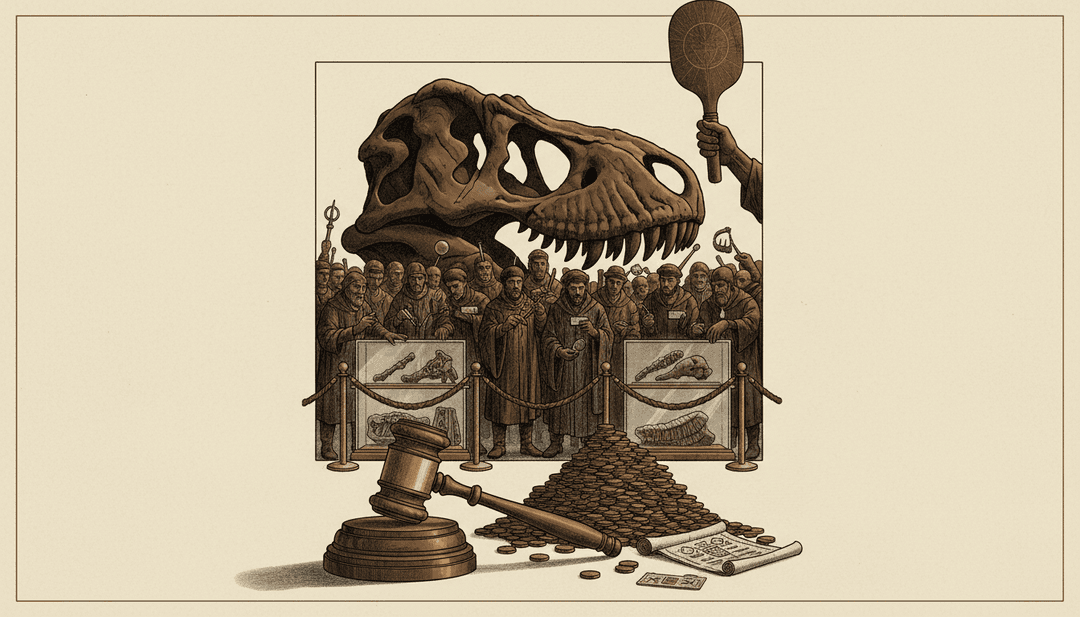
The pursuit of prehistoric relics has reached an unprecedented peak, transforming ancient bones into the ultimate trophy assets for the world's most affluent collectors. At the center of this modern gold rush is a Tyrannosaurus rex named Gus, whose recent sale has redefined the financial boundaries of the natural history market. According to Artnet News, the fossil fetched a staggering fifty million dollars, a sum that confirms the intense demand for apex predators of the prehistoric world. This transaction highlights a broader trend where ancient specimens are no longer viewed merely as scientific treasures, but as highly coveted masterpieces of natural art that command prices competitive with the finest works of modern painting and sculpture. The auction room dynamics for such pieces have evolved, drawing in a diverse group of bidders who previously focused exclusively on blue-chip fine art or rare automobiles.
For active collectors and market professionals, this fifty-million-dollar benchmark represents a fundamental change in how natural history assets are valued and traded. When a single specimen commands such an extraordinary sum, it establishes a new valuation ceiling that will inevitably influence every subsequent fossil transaction on the secondary market. Appraisers and specialty dealers must now recalibrate their expectations for high-profile dinosaur discoveries, as the pool of potential buyers expands to include traditional art collectors who view these ancient skeletons as unique sculptural centerpieces. This influx of capital ensures that private acquisition will remain a dominant force in the market, potentially making it increasingly difficult for public institutions to compete at auction. The financial implications are vast, as dealers must now consider the premium associated with complete skeletons when advising clients on potential acquisitions.
This escalating commercial interest has sparked a profound debate within the scientific community regarding the preservation and accessibility of rare fossils. As reported by Artnet News, the prevailing fossil fever has driven values to heights that effectively price out public museums and research institutions, which typically operate on limited acquisitions budgets. When premier specimens like Gus enter private collections, researchers often lose the opportunity to study them, raising concerns about the long-term impact on paleontological science. For collectors, however, stewardship of these ancient relics carries a unique prestige, as they become the custodians of history, balancing their private enjoyment with the potential for future public exhibition or collaborative study. This tension between private ownership and public access is likely to intensify as prices continue to rise.
The financial momentum behind fossil collecting is driven by the sheer scarcity of complete, high-quality dinosaur skeletons. Unlike traditional fine art, where an artist might produce hundreds of works over a lifetime, the earth yields only a finite number of well-preserved apex predators, making each discovery an exceptionally rare market event. This absolute scarcity creates a highly competitive bidding environment whenever a major specimen becomes available. As the market adjusts to this new fifty-million-dollar reality, the incentive for commercial excavation and exploration will likely intensify, leading to more discoveries but also heightening the scrutiny surrounding the legal and ethical provenance of these ancient treasures. Collectors must conduct rigorous due diligence to ensure that their acquisitions are legally sourced and documented.
Furthermore, the rising tide of fossil values has created a vibrant ecosystem of specialized advisors, conservators, and appraisers who cater specifically to this niche asset class. The physical challenges of transporting, mounting, and preserving a multi-ton dinosaur skeleton require a level of expertise that few traditional art handlers possess. Consequently, the cost of ownership extends far beyond the initial hammer price, encompassing ongoing conservation and security measures. For the modern collector, these operational considerations are a necessary part of maintaining a world-class collection, further establishing fossil collecting as a pursuit reserved for the ultra-wealthy.
Ultimately, the sale of Gus demonstrates that the appetite for natural history collectibles shows no signs of waning. The intersection of scientific wonder, extreme rarity, and immense wealth has created a robust market where prehistoric fossils are celebrated as the ultimate luxury assets. For the professionals navigating this space, the challenge will lie in balancing the commercial enthusiasm of wealthy buyers with the ethical considerations of scientific preservation, ensuring that the passion for collecting these ancient giants continues to enrich both private collections and our collective understanding of the deep past.
Sources & further reading
- 1.According to Artnet News, the fossil fetched a staggering fifty million dollars, a sum that confirms the intense demand for apex predators of the prehistoric world. — news.google.com
- 2.As reported by Artnet News, the prevailing fossil fever has driven values to heights that effectively price out public museums and research institutions, which typically operate on limited acquisitions budgets. — news.google.com